
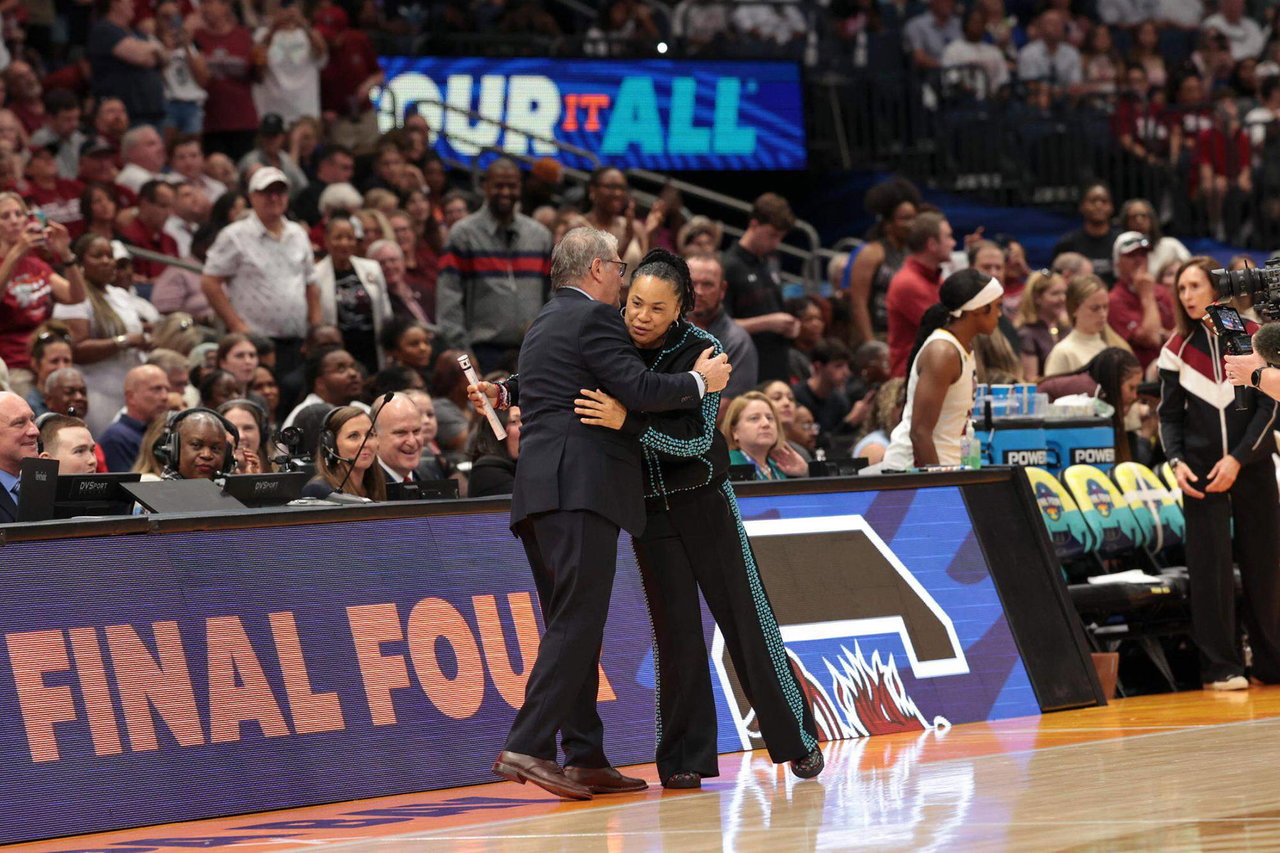
For years, Dawn Staley had to make herself walk up to Geno Auriemma after games and congratulate him, even when his UConn teams had beaten South Carolina by 20, 30, or even 40 points. Auriemma had built UConn into one of women’s college basketball’s most dominant programs, and his teams repeatedly exposed the gap Staley was trying to close at South Carolina. But Staley saw them as necessary to her program’s growth, believing that repeated exposure to UConn would eventually help the Gamecocks bridge that gap. The defeats were difficult to swallow, but Staley continued to acknowledge Auriemma after them. That history took on a new dimension on April 3, 2026.
Watch What’s Trending Now!
South Carolina defeated UConn 62-48 in the Final Four, ending the Huskies’ 54-game winning streak and advancing to its third consecutive national championship game. In the closing seconds, Auriemma and Staley became embroiled in a heated exchange that required staff members to intervene, turning a major victory into a postgame controversy.
Auriemma later attributed his frustration to a perceived snub during the pregame handshake routine, while Staley said she had no idea what she had done to upset him. Now, reflecting on the incident during an appearance on Grey Matter with Declan Kelly, Staley has offered a broader perspective on their relationship, making it clear that, in her view, the confrontation had “very little to do with the handshake.”
“I’m gonna speak about it right now, because I haven’t talked about it,” Staley said during an appearance on Grey Matter with Declan Kelly.
“Geno really thinks it’s about the handshake, and it has very little to do with the handshake… I respect, you know, what he’s done for the game, and I think he’s a genius of a coach. Understand this. When we play UConn, whether I was at Temple or here in South Carolina, and they were the overarching favorites, and they played that way, and they beat us… I made a point to always, after the game, shake his hand, look him in his eye, congratulate him, and move on. “
Staley’s recollection of her mindset provides context for the confrontation that took place on April 3, 2026. South Carolina had just beaten UConn 62-48 in the national semifinal to advance to their third consecutive national championship game, ending the Huskies’ 54-game winning streak. What was already a high-stakes night turned emotionally charged soon after.
It made sense considering her recent history. Auriemma and UConn hold a 9-7 advantage over Staley and the Gamecocks in the head-to-head between the two sides. However, things had shifted in Staley’s favor, with South Carolina winning seven of the nine most recent showdowns.
The handshake itself quickly became central to the dispute between the two sides. Auriemma later explained that he had waited for Staley at midcourt before the game for three minutes, and her not reaching out had upset him. Staley, however, had “no idea” what happened.
“I’m going to let you know this: I’m of integrity,” she said when asked about the incident.
“If I did something wrong to Geno, I had no idea what I did. I guess he thought I didn’t shake his hand at the beginning of the game. I didn’t know. I went down there pregame, shook everybody on his staff’s hand. I don’t know what he came with after the game, but hey, sometimes things get heated. We move on.”
The reason why Staley was confused was that she had already shaken Auriemma’s hand earlier in the pregame preparation, but not after introductions. According to official NCAA policies, after starting lineups are announced, the coaches of the two sides are supposed to shake hands at midcourt.
A day later, Auriemma issued an apology for the confrontation through a statement, with Staley making it clear that she had already moved on to the Gamecocks’ national title game against UCLA and wanted to put the situation behind her.
Earlier this year, upon looking back at the incident, Auriemma expressed regret for how it played out.
“I’ve lost more games in the Final Four than any coach in history. But Friday I lost something more important. I lost myself,” Auriemma wrote.
He added that Staley and her team “deserved better from me” and said the two coaches had agreed to move on. Staley also publicly called for the controversy to be put to rest, emphasizing that she had “a great deal of respect” for Auriemma and what he had contributed to women’s basketball. She argued that one incident should not define his career and urged the public to refocus on the sport’s continued growth.
The timing mattered: South Carolina went on to lose the national championship game to UCLA 79-51 on April 5. Staley’s subsequent statement came after the Gamecocks’ season had ended, when she wanted attention to return to the broader development of women’s basketball rather than remain fixed on the semifinal confrontation.
Auriemma revisited the incident publicly on May 4, in his first news conference since the exchange. By then, he had apologized twice and spoken directly with Staley, but he acknowledged that he still regretted how the moment unfolded.
“You do things in the spur of the moment sometimes, but they usually come from things that have been building up for some time,” Auriemma said.
“When I walked into the locker room afterward, you’re just shaking your head going, five more seconds, you couldn’t keep it in for five more seconds? … I just feel like a dumba– for the way it played out. We are all human and we all do dumb s—.”
Auriemma also addressed the public reaction, conceding that some criticism was warranted while arguing that other responses had been amplified by the media and social media. “I brought the criticism on myself,” he said. He maintained that he had apologized and moved on, even as he pushed back against what he viewed as an overly one-sided account of the backlash.
Now, after Staley’s view on the situation has been revealed, it provides a more personal explanation of the history behind the incident, emphasizing that her respect for Auriemma can exist alongside the competitive emotions that have accompanied their rivalry.