
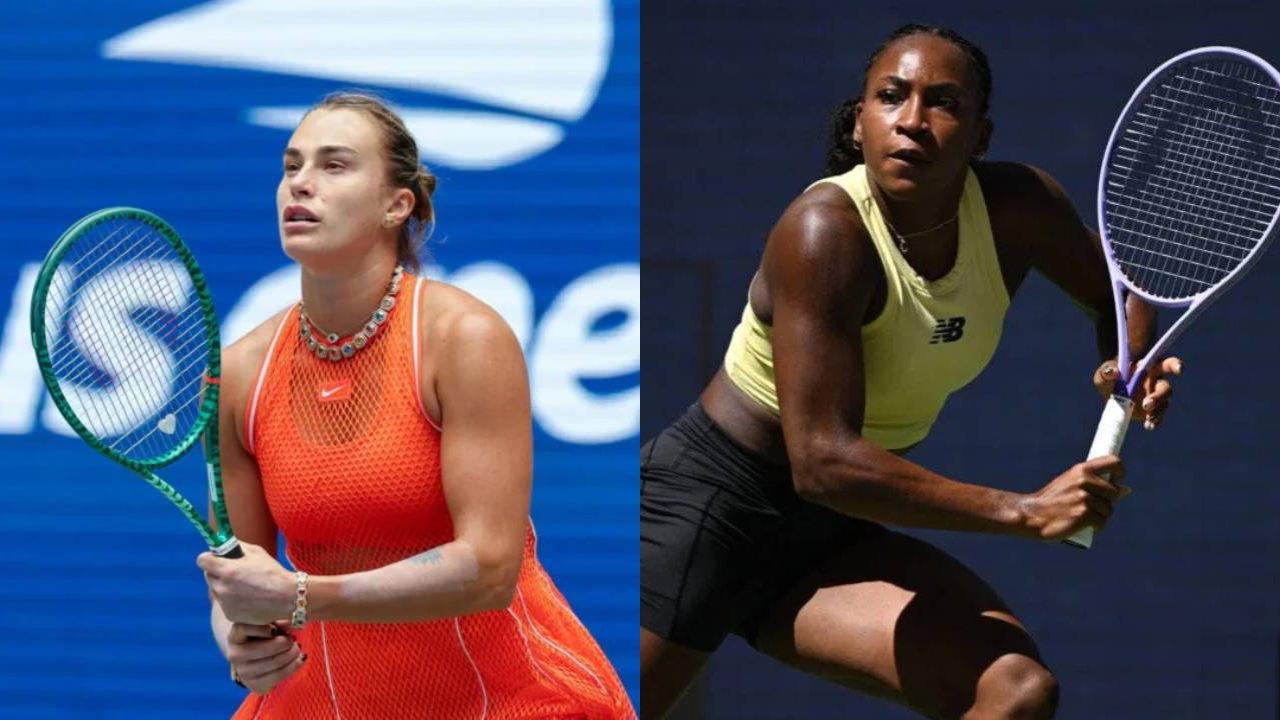
The WTA Finals draw has split tennis’ two biggest stars into separate paths—setting up a potential showdown. Aryna Sabalenka (world no. 2) and Coco Gauff (world no. 4) are on opposite sides of the draw, so they won’t meet until the final stage. The official draw has confirmed the paths of the elite eight-player field, with Sabalenka and Gauff not meeting in the group stage.
Watch What’s Trending Now!
The draw immediately sparked debate among analysts about the collision course ahead. The two bring vastly different styles—Sabalenka’s raw power against Gauff’s defensive court coverage—and momentum that will shape the tournament. They’re positioned such that they’re on a collision course for the year-end title. Meanwhile, both groups are filled with WTA stars that are going to charge the year-end battle in Indian Wells.
Group A Pitches Heavy Hitters into Battle
The top half of the draw sees Coco Gauff in Group A with World No. 1 and top seed Elena Rybakina. Rybakina, who won two Grand Slams this year, enters as the world No. 1 seed. Gauff’s route to the knockouts is going to be a very tough one as Group A is full of firepower, pace and baseline threats.
Rybakina was very focused during the draw ceremony. “It has been an unbelievable couple of months,” Rybakina said during Tuesday’s draw ceremony. “It is, of course, pressure because of all of the attention, but at the same time it’s motivation because you don’t want to lose. In this sport, you still need to work a lot.”
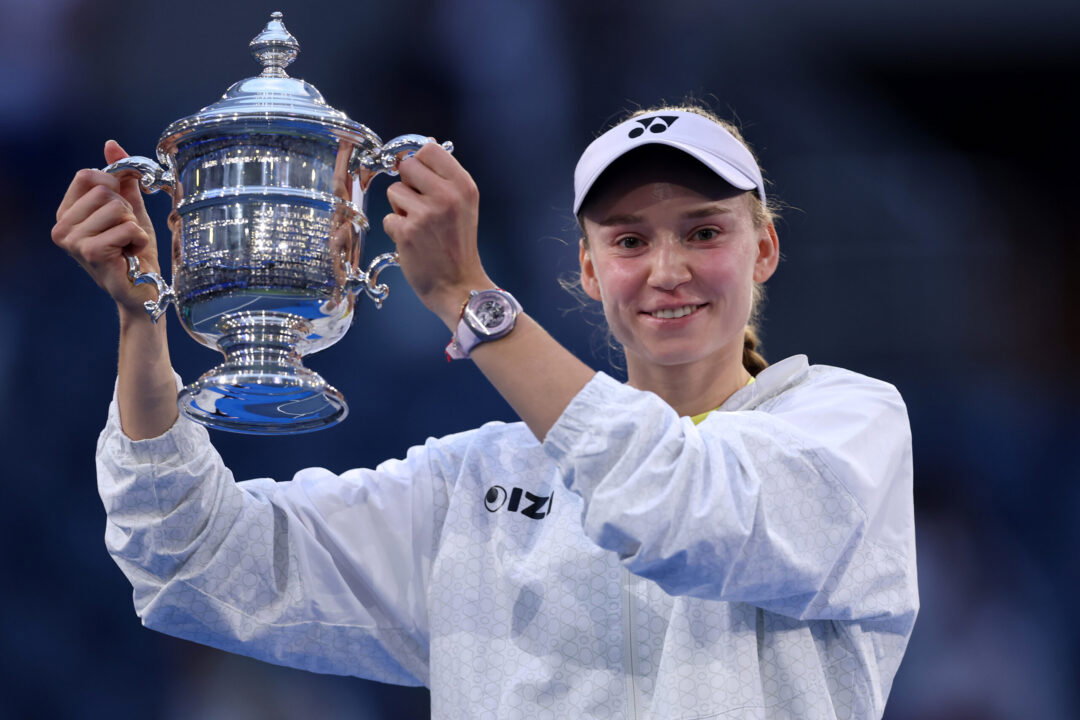
Getty
NEW YORK, NEW YORK – SEPTEMBER 12: Elena Rybakina of Kazakhstan celebrates with the trophy after defeating Aryna Sabalenka in their Women’s Singles Final match on Day Fourteen of the 2026 US Open at USTA Billie Jean King National Tennis Center on September 12, 2026 in the Flushing neighborhood of the Queens borough of New York City. (Photo by Julian Finney/Getty Images)
World No. 5 Jessica Pegula joins Gauff and Rybakina in Group A, which will see an all-American clash. Pegula’s flat, metronomic baseline forces opponents to create their own tempo. The group also features the rising star Linda Noskova, who qualified as the 8th seed. Noskova brings real baseline aggression and can take on any elite on an indoor hard court.
Gauff must protect her service games throughout the group stage. She has the tools to deal with big servers in Rybakina and Noskova. The danger is, of course, if she’s not disciplined in those three matches, as it’s a round robin and it’s sets and games that will decide who goes through to the semis. She’s got a massive amount of motivation to go out there and take the year-end title and reassert herself as a top-tier champion.
Sabalenka Headlines Group B With Power
Sabalenka is the No. 2 seed, and she’s the one who anchors Group B. She’s come into the season finale looking to re-establish her total dominance on the tour. A player who’s always been about the groundstrokes and the serve, she’ll be avoiding both Gauff and Rybakina in the first round. She’ll face a very tricky group of three, though, in terms of variety, patience, and mental fortitude.
Sabalenka’s Group B includes teenage phenom Mirra Andreeva. Andreeva is a very intelligent player, has excellent shot selection, and is incredibly composed for her age. She’s a player who will often absorb the pace and go to the other side of the ball. She’s a very interesting opponent for Sabalenka in that you can’t just go out and hit the ball at her. You have to construct the points very carefully, and you have to be very careful not to make unforced errors.
Elina Svitolina is the experienced competitor in the group, a player who is all about defensive retrieval and counter-punching. She’s very much a player who will go for the long rallies and will regularly wear down the more impatient opponents. The other player is seventh seed Karolina Muchova of the Czech Republic. She’s one of the most complete players in the game, capable of dropping the ball, coming to the net all the time, and using all sorts of slice spins to break up the baseline.
Sabalenka must balance her trademark power with tactical restraint to navigate her group. She’s been pretty open about the ‘channeled fire’ she has and the respect she has for her fiercest rivals, Gauff in particular. “Honestly, I don’t know what else to say. But I want to start with you,” she sent a few compliments in Gauff’s direction. “You’re a fighter. You also pushed me so hard to be a better player, and I like our rivalry. You’re incredible.”
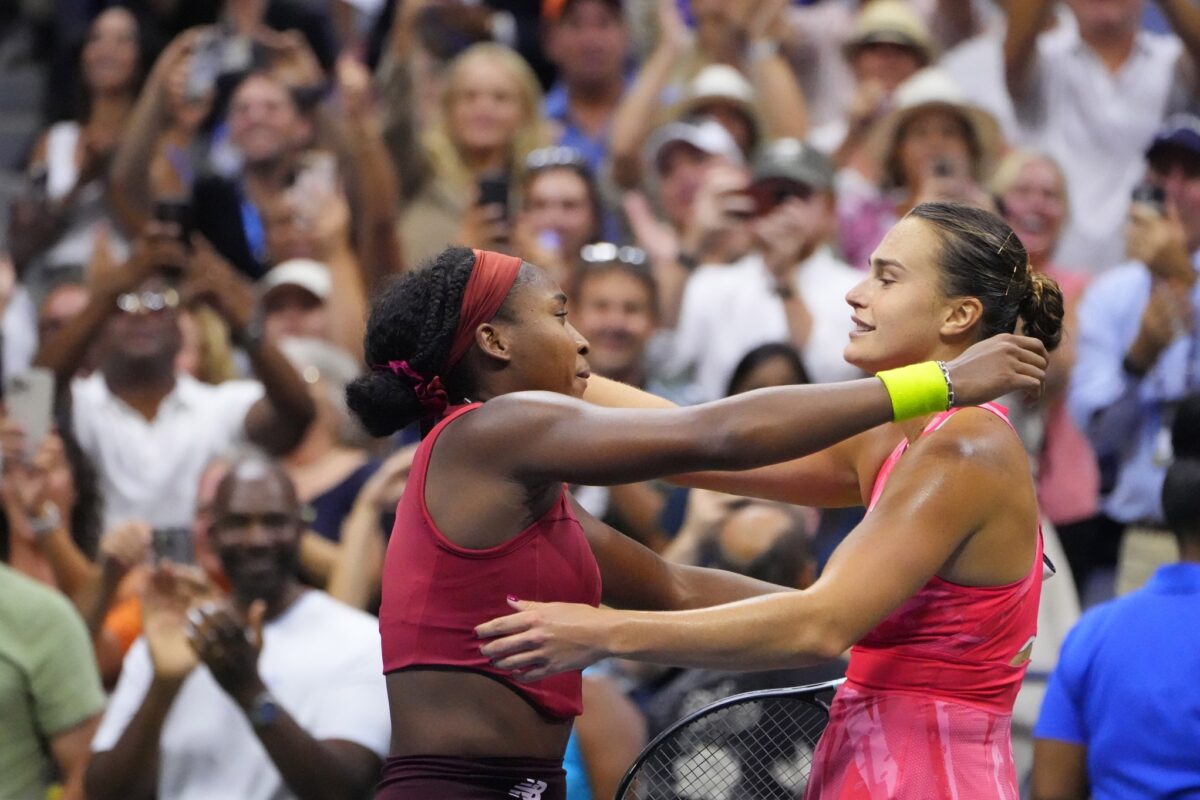
USA Today via Reuters
Sep 9, 2023; Flushing, NY, USA; Coco Gauff of the United States (L) hugs Aryna Sabalenka (R) after their match in the women’s singles final on day thirteen of the 2023 U.S. Open tennis tournament at USTA Billie Jean King Tennis Center. Mandatory Credit: Robert Deutsch-USA TODAY Sports
Clash of Styles Before the Knockout Stage
Keeping Sabalenka and Gauff apart maximizes the chance of a showdown. That’s the rivalry that tennis fans love to watch. It’s always been a game of long rallies and huge shifts in momentum. Keeping them apart in the group stage ensures the possibility of an absolutely thrilling final.
The history between the two players is massively significant in terms of this potential clash. Sabalenka has a very slight 7–6 advantage in their head-to-head record, which speaks volumes as to how close the two are. Gauff famously defeated Sabalenka in three sets to take her first major at the 2023 US Open, but Sabalenka has since answered that with key hard court wins at the Australian Open and most recently in the Miami Open final. Their matches are always physical battles to the very end. It’s not just about the trophy, though. A Finals meeting is a huge psychological battle too. It’s about who is the best in the world, and it’s about whose game is the one that ultimately dominates the modern game.
The WTA Finals format only rewards the top two from each group, with those two progressing to the single-elimination semi-finals. So if Sabalenka wins Group B and Gauff is runner-up in Group A, they will meet in the semi-finals. If both of them win their groups, then they can only meet for the year-end trophy. That would be the ideal scenario for the organisers, the media and the fans around the world.
The tournament format also has a big influence. The courts are set up to favour the player who takes the ball early and plays bold, aggressive shots, but they’re also very much in favour of the player who can retrieve the ball consistently and turn defence into attack. Gauff’s movement allows her to neutralise the attacking player, and Sabalenka’s sheer weight of shot can cut through the court’s friction. Both of them are acutely aware of the situation and know that to lift the trophy they’re going to have to go through four or five very tough matches against the top ten.
The 2026 draw is balanced, full of intrigue and high stakes in both the round robin pools. Sabalenka and Gauff are on completely separate paths at the moment, with the onus of having to prove themselves against the very best. With Rybakina, Pegula, Andreeva and Muchova all in a position to be the spoiler, neither of the stars has an easy route out of group play. It’s all set; if Sabalenka and Gauff can get through their pools, we’re in for another chapter in what is becoming a very compelling rivalry.