
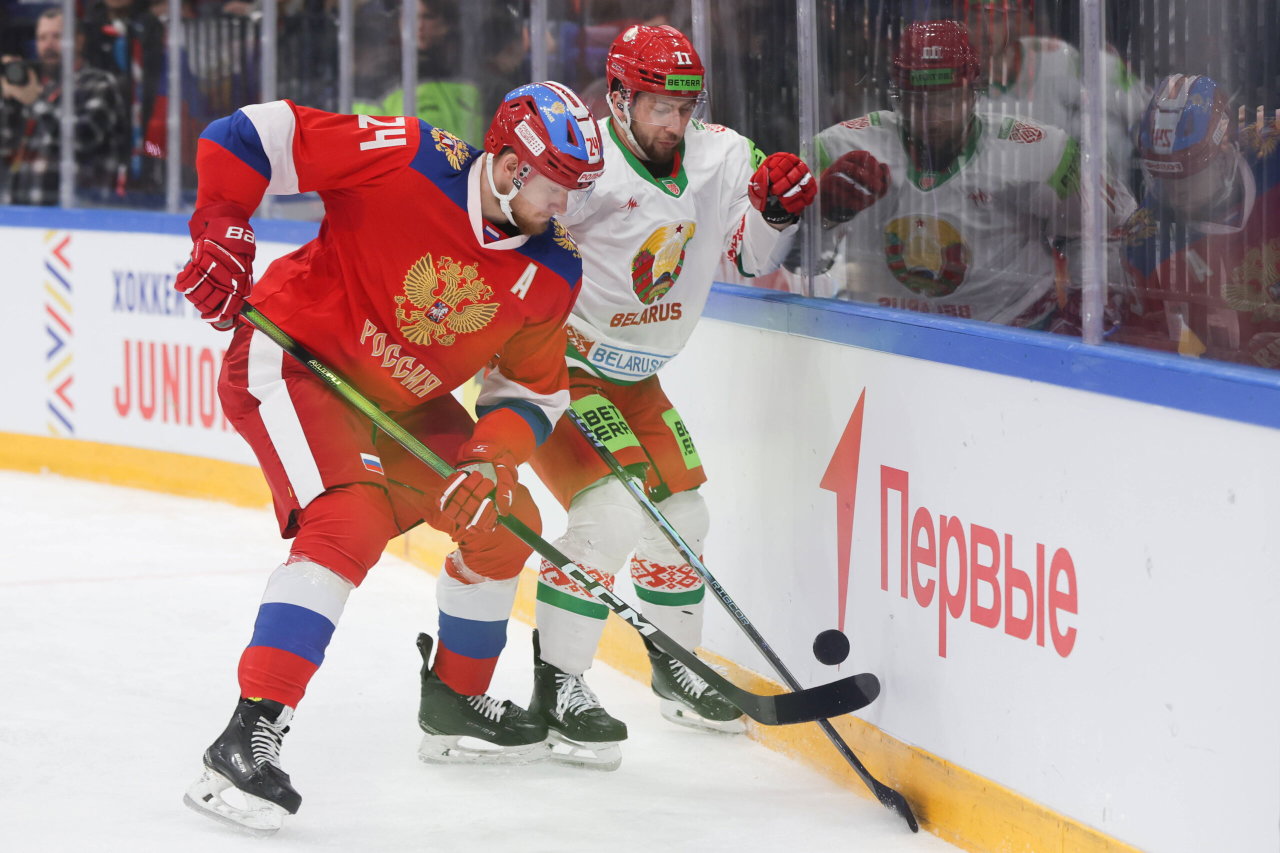
The International Ice Hockey Federation (IIHF) is facing an increasingly difficult situation as the debate over Russia’s return to international competition threatens to disrupt the sport. While the governing body has confirmed Belarus’ continued exclusion from upcoming tournaments, its position on Russia remains uncertain, leaving several participating nations unwilling to share the ice with the country.
Watch What’s Trending Now!
In an announcement on Saturday, November 7, the IIHF confirmed that Belarusian national teams would miss the 2027 World Junior Championship and the 2027 Men’s World Championship. However, the federation stopped short of making a similar decision on Russia, instead exploring possible arrangements for its return despite growing opposition from several hockey nations.
Yet the IIHF’s decision to keep Belarus out comes just days after CAS overturned its original exclusion of both countries – a ruling that the federation had failed to provide sufficient grounds to maintain the restrictions. Now, the latest developments suggest that the governing body is taking a different approach toward the two countries.
The IIHF’s latest decision followed a ruling by its Disciplinary Board, which partially upheld the Belarusian Ice Hockey Association’s appeal against the federation’s July 27, 2026, decision. However, the board maintained that it had no legal grounds to order Belarus’ immediate reintegration.
The governing body also pointed to existing tournament arrangements, including competition formats, schedules, ticketing, and operational planning, as reasons for keeping Belarus out of the 2027 events.
“In accordance with the principles approved by the 2022 IIHF Semi-Annual Congress, the IIHF Council has decided that Belarusian U20 and senior men’s national teams will not participate in the IIHF World Junior Championship 2027 and the IIHF World Championship 2027, respectively,” the federation stated.
The decision immediately drew a strong response from Belarusian officials, who questioned the reasoning behind the federation’s approach.
The Belarusian Ice Hockey Federation announced that it was considering further legal action, including another appeal to CAS, to protect the rights of its national teams. It also argued that sufficient time remained before the 2027 Men’s World Championship in Germany to resolve the organizational concerns cited by the IIHF.
Federation chairman Alexander Bogdanovich was particularly critical of the apparent difference in treatment between Belarus and Russia. “The decision essentially replicates the outcome of the previous cancellation: Belarusian teams are once again excluded from the tournament, with only the rationale changing,” Bogdanovich said.
He also questioned the inconsistency, pointing out that the IIHF was prepared to examine the organizational changes necessary for Russia’s potential return but had not considered applying a similar approach to Belarus.
CAS ruling and growing boycott threaten international hockey
While Belarus continues to challenge its exclusion, the IIHF has taken a different position on Russia. Although the federation maintains its disagreement with CAS, it has acknowledged that it must work within the tribunal’s ruling and examine the conditions necessary to facilitate Russia’s potential participation.
“While the IIHF continues to disagree with the decision of the Court of Arbitration for Sport (CAS) concerning Russian participation in IIHF Championships, we are taking the necessary steps required by the CAS ruling and reviewing what conditions would need to be met to safeguard our Championships, protect the organization’s financial stability, and secure the long-term future of international ice hockey,” the federation stated.
CAS defended its October ruling on November 5, explaining that its decision rested on the legal arguments and evidence presented during the proceedings. According to the tribunal, the IIHF failed to provide sufficient evidence to justify maintaining the exclusion on security grounds.
However, CAS clarified that its ruling did not determine whether Russia should compete under its national flag or as neutral athletes. Nor did it address the organizational arrangements required to facilitate its return.
The legal decision has done little to settle the sporting dispute. Sweden, Finland, the Czech Republic, Norway, Latvia, and Denmark have indicated their willingness to boycott games against Russia while the war in Ukraine continues. Germany, which will host the 2027 Men’s World Championship, has also raised the possibility of withdrawing if Russian participation goes ahead.
The financial implications are becoming difficult to ignore, too. STRAUSS, a major sponsor of the 2027 World Championship, has threatened to withdraw its support following Finland’s efforts to rally other nations against playing Russia.
Switzerland has also drawn a distinction between participating in the World Juniors and facing Russia, confirming that its national team would not play against the country while remaining committed to the tournament.
Canada has taken an even firmer position. Prime Minister Mark Carney announced that Russian athletes would not be permitted to enter the country for next month’s World Junior Championship in Alberta. Hockey Canada has backed that position, creating another obstacle for the IIHF as it examines Russia’s possible return.
Russia, meanwhile, has continued to criticize the restrictions. President Vladimir Putin accused international sporting organizations of imposing politically motivated sanctions that violate legal commitments and court rulings.
With the World Juniors approaching, the IIHF now finds itself caught between legal obligations and the concerns of its participating members. Its willingness to explore Russia’s return while keeping Belarus out has also raised fresh questions about consistency within the governing body.
The federation wants to preserve international competition, but its efforts to find a solution have yet to convince the countries threatening boycotts. And with Belarus considering another legal challenge and Russia’s participation still unresolved, the IIHF has a much bigger problem than simply deciding which teams will take the ice.