
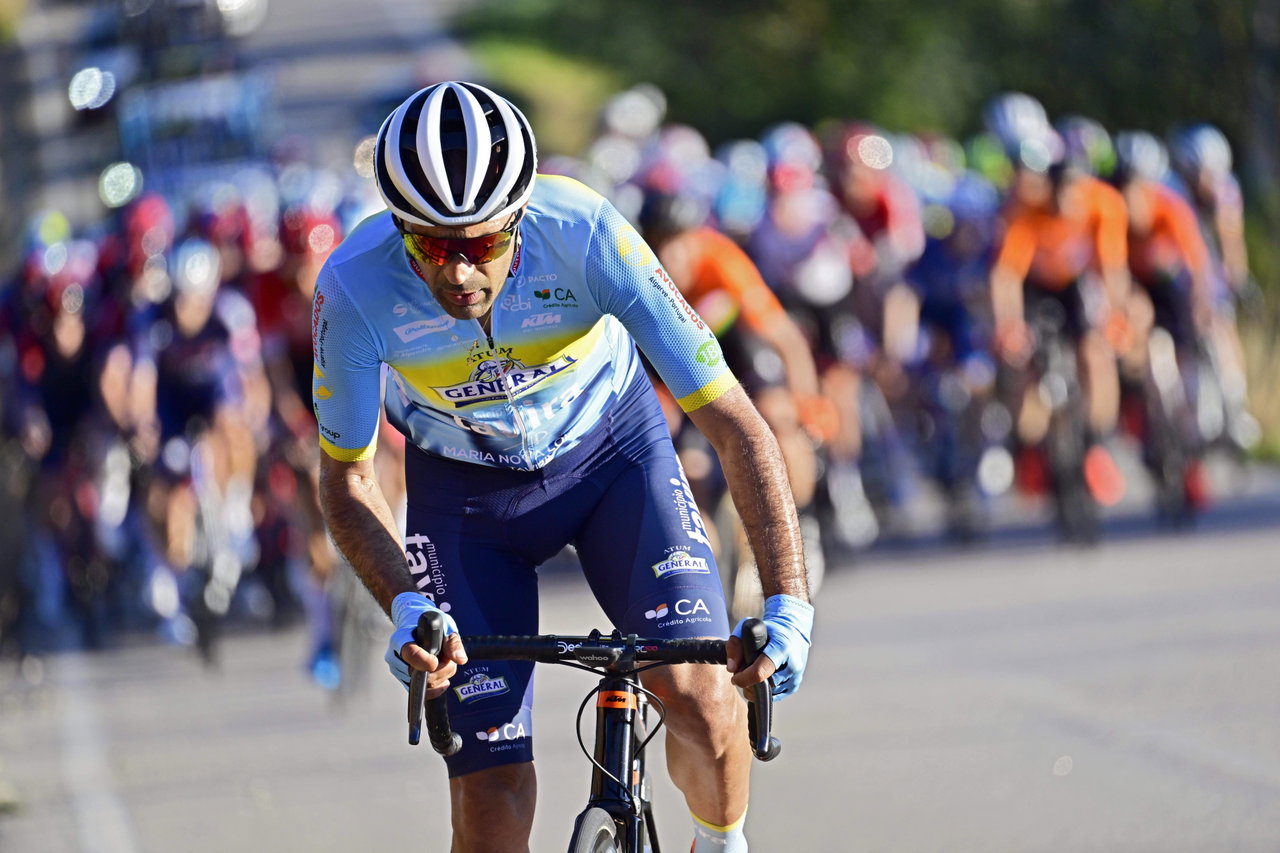
For Delio Fernandez, retirement seemed to close his cycling career. However, more than a year after leaving the sport, the Spaniard is facing the consequences of an investigation that dates back over a decade. The 40-year-old has received a four-year suspension after the UCI Anti-Doping Tribunal established an anti-doping rule violation through his Athlete Biological Passport (ABP).
Watch What’s Trending Now!
The International Testing Agency (ITA), which oversees the UCI’s anti-doping program, confirmed that the case involved blood samples collected during two editions of the Tour of Portugal. The first set came on July 28 and August 5, 2015, while the second involved samples taken on August 15 and 17, 2023. Interestingly, Fernandez won stages in both editions, making the timing of the findings particularly significant.
The case centers on the Athlete Biological Passport, a system that monitors changes in an athlete’s biological markers over time. Rather than relying exclusively on conventional positive drug tests, it helps authorities identify unusual patterns in an athlete’s blood profile that could indicate the use of prohibited substances or methods.
In Fernandez’s case, independent experts found enough evidence to support the allegations. The ITA confirmed that the experts unanimously concluded that the changes in his biological passport values were “highly likely to have been caused by a prohibited substance or method.” Following the assessment, the UCI Anti-Doping Tribunal established a violation under Article 2.2 of the UCI Anti-Doping Rules concerning the use of a prohibited substance or method.
The UCI initially handled the results management process before the ITA took over the disciplinary proceedings. The agency assumed responsibility for the legal proceedings on behalf of the UCI following a delegation in February 2026. After reviewing the evidence, the Tribunal delivered its decision on November 12, handing Fernandez a four-year period of ineligibility.
The suspension will remain in place until November 11, 2030. However, the punishment extends beyond keeping him away from competition. The Tribunal has also disqualified all his individual results across two separate periods. The first stretches from July 28, 2015, to July 27, 2019, while the second begins on August 9, 2023, and runs until the start of his suspension.
Fernandez’s case is not the only recent anti-doping matter handled by the ITA in cycling. The agency has also taken action against South African rider S’annara Grove following an adverse analytical finding during the 2026 Commonwealth Games in Glasgow.
In August 2026, the ITA confirmed that Grove had been provisionally suspended after a sample collected during an out-of-competition test on July 28 returned an adverse analytical finding for ipamorelin. The substance, a synthetic peptide that stimulates the body’s natural growth hormone production, falls under the S2 category of the 2026 WADA Prohibited List and is banned both in and out of competition.
The provisional suspension was imposed under the World Anti-Doping Code and UCI regulations. Grove retains the right to challenge the decision and request its removal. As the proceedings remain ongoing, the ITA has declined to comment further.
While the ITA continues to handle fresh anti-doping cases, Fernandez’s situation stands out for a different reason: the investigation has caught up with him long after he decided to walk away from professional cycling.
Retirement offers little relief as Fernandez loses career achievements
That decision wipes out several important achievements from the Spaniard’s career, including his stage victories at the 2015 and 2023 Tour of Portugal. He also loses his 2017 Tour of Austria triumph, which he received retroactively following Stefan Denifl’s suspension. Alongside the disqualifications, Fernandez must pay a fine equivalent to 70% of his average annual gross income earned through cycling.
Fernandez and the other relevant parties, including the UCI/ITA, the World Anti-Doping Agency (WADA), and his National Anti-Doping Organization (NADO), can appeal the ruling before the Appeals Division of the Court of Arbitration for Sport (CAS).
The Spaniard turned professional in 2008 with Xacobeo-Galicia and went on to compete in the Giro d’Italia and Vuelta a España. He later became a familiar face in Portuguese cycling, racing for W52-Quinta da Lixa before spending several seasons with French outfit Delko Marseille Provence.
He returned to Portugal in 2022 with AP Hotels & Resorts-Tavira-SC Farense and continued racing until April 2025, when he announced his retirement. Consequently, the four-year ban will keep him out of competition until he is 44, even though he has already stepped away from professional cycling.
His case also adds to the growing list of doping controversies in Portuguese cycling. The W52 setup faced major scrutiny in 2022, when several riders received suspensions, while other figures from the Portuguese peloton, including António Carvalho, Rafael Silva Venceslau Fernandes, and Francisco Guerreiro, have also faced sanctions.
For Fernandez, the ruling changes more than his competitive future. It rewrites a significant part of his career, taking away victories that once represented some of his finest moments in professional cycling.