
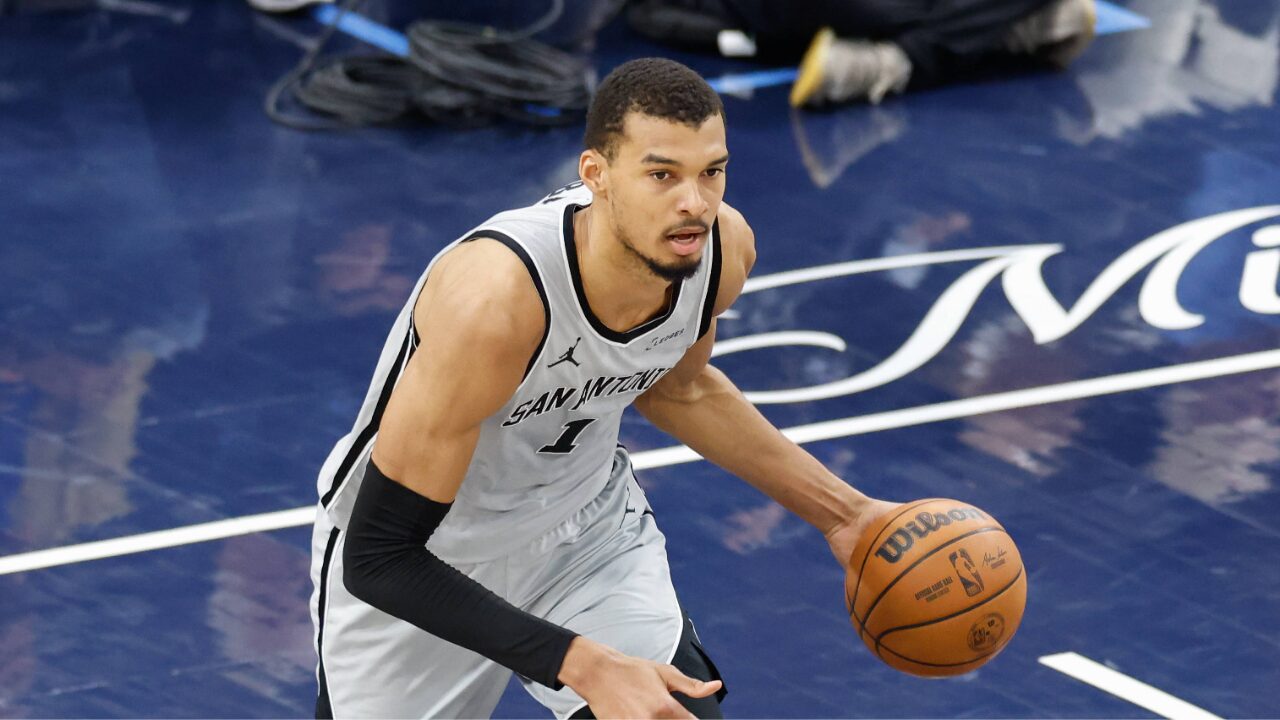
For much of NBA history, the league’s biggest individual prize belonged to the biggest players on the floor. Before guards and wings came to define the modern game, dominant centers dictated its terms- and, for years, the MVP race reflected that reality. That era eventually gave way to a perimeter-driven league, with guards and forwards becoming the game’s most influential stars. But according to Julius “Dr. J” Erving, that pendulum could be swinging back. And there is one player in particular who he believes could lead the charge- Victor Wembanyama.
Watch What’s Trending Now!
Speaking to Brandon “Scoop B” Robinson, Erving was asked where he sees his ‘direct stylistic lineage’ in today’s game and how he feels about the evolution of the wing player. His answer instead traced the NBA’s changing hierarchy through its MVP history.
“Well, you know, the forwards and guards dominated the game. It was a game dominated by centers in my day, and as a matter of fact, the MVPs from 1966 to 1982 were all centers. Oscar Robertson was one before, and I was the one during that year.”
Although statement from Dr. J is largely accurate, it needs a minor tweaking. In the year 1975 and 1981, a traditional big man didn’t win the MVP.
1975 – Bob McAdoo (Center/Forward)
1981 – Julius Erving (Small Forward)
Erving’s point highlights how completely centers once controlled the league. From Wilt Chamberlain and Bill Russell to Kareem Abdul-Jabbar and Moses Malone, dominant big men defined the MVP race.
“And suddenly it came guards and forwards who were, like, the MVPs of the league, and that has maintained today, although I think Wemby’s gonna change that.”
That shift eventually defined the modern NBA. Larry Bird, Magic Johnson and Michael Jordan helped establish guards and forwards as the league’s dominant stars.
Meanwhile, the rise of three-point shooting, ball-handling and pace pushed the game even further toward the perimeter.
Now, Erving sees Victor Wembanyama as the player capable of reversing that trend.
The prediction makes sense when looking at Wemby’s unique skill set. At 7’4 with an 8-foot wingspan, he has the physical profile of a traditional center, yet he can handle the ball and shoot with the skill of a modern wing. He can protect the rim, rebound, and finish inside without being confined to the paint.
That combination gives him a chance to bridge two eras. Victor Wembanyama doesn’t need the NBA to abandon its perimeter-oriented identity. Instead, he could use the skills of the modern game to make the center position overwhelmingly valuable again.
And that is precisely why Erving believes he could change the league’s MVP hierarchy.
Victor Wembanyama is already closing the gap
There is already evidence that Ervings’s prediction is not as far-fetched as it sounds. During the 2025-26 season, Wembanyama finished third in the MVP race behind Shai Gilgeous-Alexander and Nikola Jokic.
He averaged 25.0 ppg, 11.5 rpg, and league-leading 3.1 bpg while also winning the DPOY award unanimously.
Now, the Spurs have added Tobias Harris, giving Wembanyama another reliable forward alongside him. Harris could help solve one of the biggest problems facing a dominant interior player: space.
With Harris stretching the floor, defenses should have less freedom to collapse around Victor Wembanyama. Double-teams become harder to execute, driving lanes can open up, and the Spurs star should have more room to attack the basket or operate from the post.
That could directly affect his scoring.
Wembanyama already averaged 25 points last season. But improved spacing could create cleaner possessions and more efficient opportunities. If Harris, alongside Stephon Castle, De’Aaron Fox, and Dylan Harper, forces defenders to respect him on the perimeter, Wemby can spend less time battling through crowded defenses and more time attacking individual matchups.
For a player still developing, that could unlock another level. More room around him could allow his offensive production to rise naturally while making it harder for opponents to build their entire defensive scheme around stopping him.
That is where Erving’s prediction becomes particularly interesting. Victor Wembanyama combines the physical advantages of a traditional center with the perimeter skills of the modern NBA.
Perhaps the one that finally brings a center back to the top.