
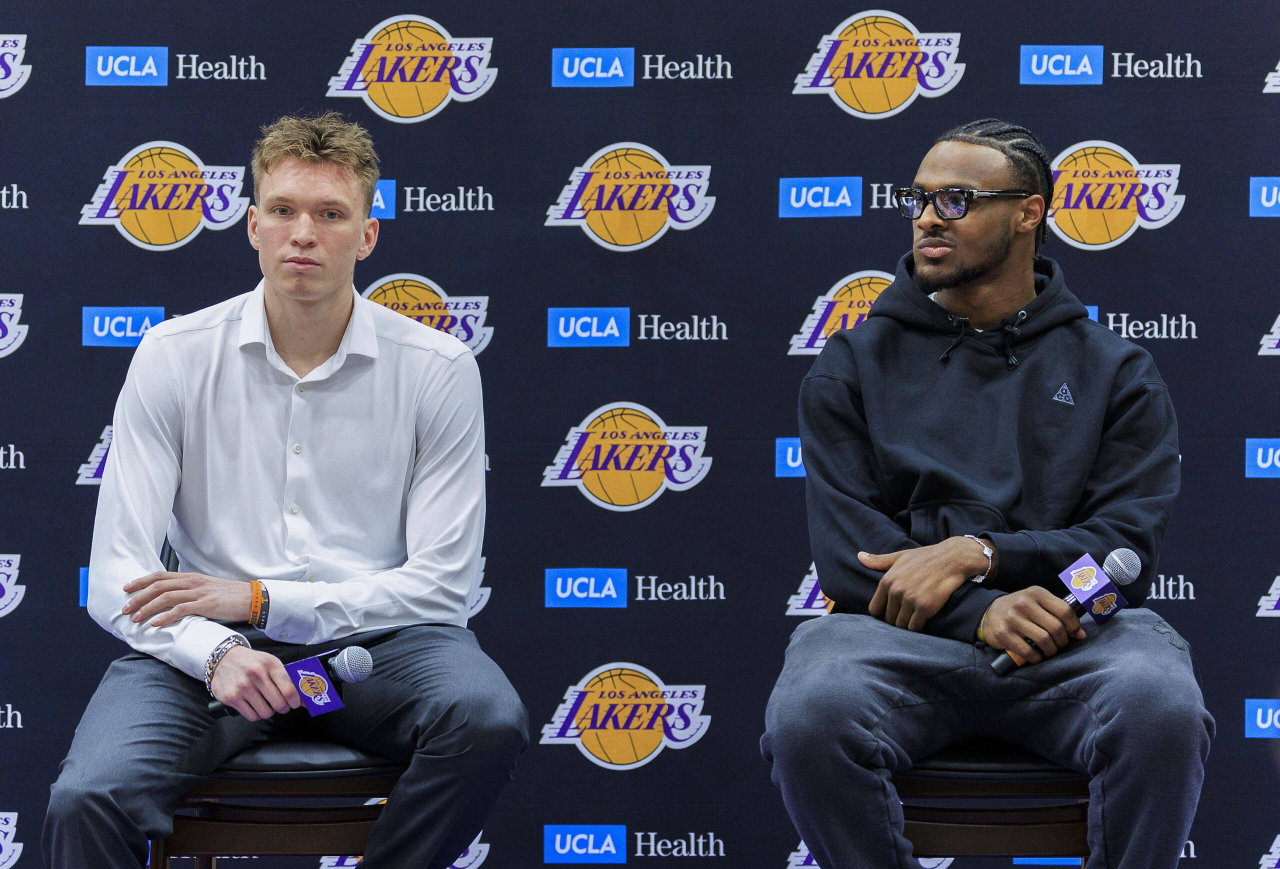
On November 19, 2024, Dalton Knecht gave Lakers fans a glimpse of what they thought they had found. The rookie scored 37 points against the Utah Jazz, knocking down nine three-pointers to tie the NBA record for most threes by a rookie in a game. He even scored 21 points in the third quarter, turning a promising night into a performance nobody in Los Angeles would forget anytime soon.
Watch What’s Trending Now!
Less than two years later, the Lakers have waived Knecht. The former No. 17 pick is out after the franchise failed to find a trade for him, while Bronny James, selected 55th in the same draft, remains on the roster. The decision marks a stunning turn for a player LeBron James once believed would translate beautifully to the NBA, but the reasons go beyond one bad preseason or a crowded roster.
“Throughout the course of the college season, Dalton, besides Bronny, was my favorite player in college basketball. I watched his games throughout the whole season. I just liked his ability to shoot the ball, his athleticism, his height, his demeanor that he played with. I’ve always kind of felt like his game would translate to the NBA.”
James said those words in July 2024, shortly after the Lakers drafted Knecht. He also admitted he never expected the Tennessee star to fall to No. 17, adding, “I didn’t know he would fall to 17, at all, so I didn’t think we would have an opportunity to get him. But I’m glad we did. I’m glad we did.” The Lakers appeared to have landed a ready-made shooter, but that early excitement would not last.
Knecht arrived in Los Angeles after averaging 21.7 points per game at Tennessee during his final college season. He was the SEC Player of the Year and a first-team All-American, and his scoring ability made him an appealing option for a team looking to add young talent around LeBron James and Anthony Davis.
His NBA start seemed to validate that decision. Knecht started nine straight games in November 2024, averaging 18.9 points and 4.9 rebounds during the stretch. The 37-point explosion against Utah was the highlight, but the larger run suggested he could become a dependable scoring option rather than a rookie who needed years to find his footing.
The problem was that shooting was only one part of the job. Knecht’s defensive limitations had been a concern before the draft, and those weaknesses became harder to overlook as his role changed and the Lakers’ roster evolved.
His rookie season ended with 9.1 points per game across 78 appearances, including 16 starts. He shot 46.1% from the field and 37.6% from three-point range, respectable numbers for a rookie wing. But his second season brought a sharp decline in both playing time and production.
Knecht appeared in 54 games during the 2025–26 regular season, playing just 553 minutes compared with 1,494 as a rookie. His scoring average fell to 4.2 points per game, while his three-point percentage dropped to 34.2%. The decline was not simply about fewer opportunities; his reduced efficiency made it harder to argue that he deserved more of them.
The defensive concerns were especially important. The Athletic’s Dan Woike reported in October 2025 that scouts continued to see holes in Knecht’s game, particularly on defense, where he was often out of position. His lateral quickness and ability to handle defensive assignments had been questioned before the Lakers drafted him, and those concerns followed him into the NBA.
Knecht could still punish teams when left open, but he offered less when his shot was not falling. He was not a proven secondary playmaker who could create for teammates or consistently attack defenses in other ways, leaving his shooting to carry much of his value. For a team trying to build a reliable rotation, that narrow role became increasingly difficult to justify.
Then came the Mark Williams trade, a moment that changed the course of Knecht’s Lakers career. In February 2025, Los Angeles agreed to send Knecht, Cam Reddish, a 2031 first-round pick and a 2030 pick swap to Charlotte for the center. The deal was supposed to address the Lakers’ need for a big man alongside Davis, but it quickly fell apart.
The Lakers announced on February 8 that the trade had been rescinded after Charlotte failed to satisfy a condition of the deal. Williams had failed his physical, sending Knecht back to Los Angeles after he had already been traded away. His playing time never returned to its previous level, although the failed deal alone cannot explain his decline.
Knecht played far less after returning, and the Lakers continued looking for ways to move him. By October 2025, scouts were reportedly increasingly pessimistic about his value. One anonymous scout described him as a “negative asset,” meaning the Lakers might have needed to attach additional pieces to convince another team to take him.
The final preseason offered little reason for optimism. Knecht averaged 2.8 points while shooting 25% from the field across four appearances, making it harder for the Lakers to sell another team on his potential. A four-game sample cannot tell the whole story, but it came after two seasons of declining playing time and months of reported trade discussions.
JJ Redick had already acknowledged that Knecht’s place on the team had become difficult to define. The Lakers had changed, the competition for wing minutes had grown, and the coach saw a player whose skill set no longer fit the team’s needs as well as it once had.
“The team changed. The team changed. The needs changed, the fit changed. I think he got better as a player over the last two years… we added a lot of wings and he’s in a tough spot right now.”
Redick’s comments offer a more complete explanation than the preseason numbers alone. Knecht had not necessarily stopped being a capable shooter, but the Lakers needed more from their wings as the roster shifted around Luka Doncic and Austin Reaves. His defensive limitations and narrow offensive role made it harder to keep him on the floor.
The Lakers tried to find a trade before making the final decision. Jake Fischer reported on October 15, 2026, that Los Angeles and Milwaukee had held exploratory discussions on a framework that would send Knecht and second-round draft capital to the Bucks for Jericho Sims. Fischer also reported pessimism among sources familiar with the talks that a deal would materialize.
The proposed deal was significant because it suggested the Lakers were willing to attach draft assets to move Knecht rather than simply exchange him for another player. Milwaukee was not confirmed to have agreed to the framework, and the talks remained exploratory. Still, the Lakers’ inability to complete a trade showed how difficult it had become to find a workable market for him.
The roster deadline eventually forced a decision. Los Angeles entered the final stretch with 16 players on standard guaranteed contracts and needed to reach the league’s 15-player limit. Knecht was waived, leaving the Lakers responsible for his guaranteed 2026–27 salary of $4,201,080. The move created no incoming player or trade return, but it cleared the roster spot.
Bronny’s continued presence makes the decision more striking, especially because both players came from the same draft class. But their situations were not identical. Knecht was a 6-foot-6 wing expected to provide shooting, while Bronny was a 6-foot-2 guard still developing his game and working toward a consistent NBA role.
Bronny showed progress in his second NBA season. His playing time increased from 6.7 to 8.9 minutes per game, while his shooting improved from 31.3% to 40.9% from the field and from 28.1% to 38.6% from three-point range. He also averaged 15.6 points while shooting 56.4% from the field and 45.6% from three in 14 G League games during the 2025–26 season.
Those numbers do not establish that Bronny is a better player than Knecht, nor do they prove that he took Knecht’s place. The Lakers were evaluating players with different positions, roles, contracts and development timelines. Bronny’s retention was a separate roster decision, not evidence that the Lakers chose him over Knecht for the same job.
For Knecht, the next opportunity will depend on whether another team believes his shooting can outweigh his defensive limitations. His rookie season showed that he can catch fire and change a game, but his time in Los Angeles also showed how difficult it is to remain in an NBA rotation when one strength cannot make up for weaknesses elsewhere.
The Lakers’ decision closes a disappointing chapter for a player who once looked like a draft-night steal. LeBron’s early praise and Knecht’s 37-point performance were not meaningless; they showed why the Lakers believed in him. But the franchise ultimately needed a more complete fit, and the promise of those early nights was not enough to keep him on the roster.