‘Said No Profanity’: Rory McIlroy Attempts Damage Control After NSFW PGA Championship Slip-Up

Add us on Google
‘Said No Profanity’: Rory McIlroy Attempts Damage Control After NSFW PGA Championship Slip-Up
Add us on Google
Imago
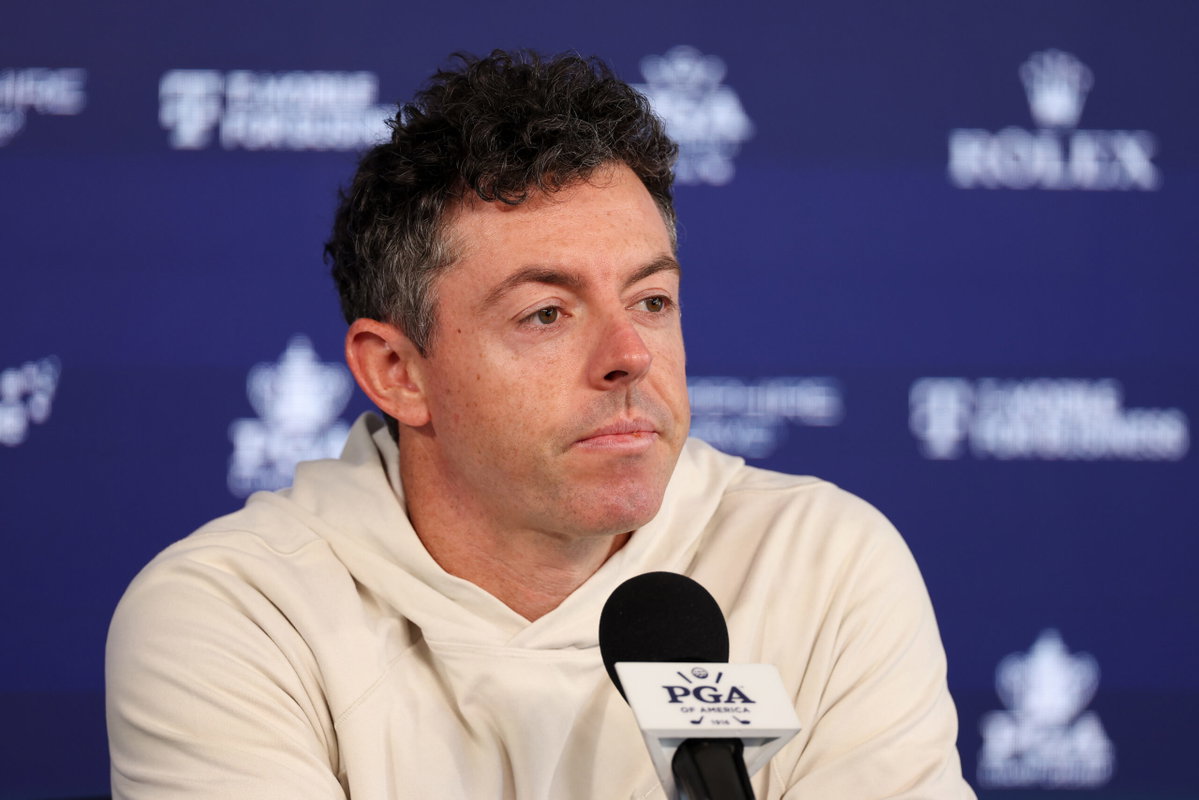
May 12, 2026; Newtown Square, Pennsylvania, Rory McIlroy speaks with the media before a practice round of the PGA Championship golf tournament at Aronimink Golf Club. Mandatory Credit: Bill Streicher-Imagn Images
Imago
May 12, 2026; Newtown Square, Pennsylvania, Rory McIlroy speaks with the media before a practice round of the PGA Championship golf tournament at Aronimink Golf Club. Mandatory Credit: Bill Streicher-Imagn Images
Forty-eight hours isn’t much time to regain composure at a major championship. For Rory McIlroy, though, it was just enough to turn his anger into a joke, and everyone in the Aronimink press room noticed right away. On Thursday, he left the 18th green looking ready to tear the course apart. By Saturday, he had entered the interview room prepared to lighten the mood.
Watch What’s Trending Now!
When a reporter started by mentioning McIlroy’s one-word summary from Thursday, he quickly responded, “Better. I said no profanity today, so keep it clean.” The room burst out laughing. The joke worked because everyone had seen just how openly frustrated he was before; it was classic McIlroy.
After describing his opening 74 as “s*” and his second round as “not as s***,” this was McIlroy’s way of acknowledging the noise around him without letting it take over the week.
Thursday’s opening round did not go as planned. McIlroy shot a four-over 74 at Aronimink, closing with four consecutive bogeys. According to The Athletic’s stats, it was his 990th official PGA Tour round and the first time he had ever carded bogey or worse on the final four holes of an opening round. On the par-4 fourth hole, his tee shot faded right into thick rough. He drove his TaylorMade Qi4D into the turf and appeared to shout an expletive that was picked up on broadcast microphones, as reported. The week had already started with issues. His regular driver was ruled non-conforming before play began, which forced him to switch equipment at the last minute. After the round, he addressed the driving problem directly.
“I’m just not driving the ball well enough. It’s been a problem all year for the most part.”
Rory HOT mic !!! pic.twitter.com/rJCgQADxEM
— Elijah Collins (@Ecollins2727) May 19, 2023
He did not leave it there. McIlroy explained that the miss had started to move both ways, which made it harder to trust the club he usually leans on most.
“I miss it right, and then I want to try to correct it. And then I’ll overdo it, and I’ll miss it left. It’s a little bit of back and forth that way. So that’s pretty frustrating, especially when I pride myself on driving the ball well.”
That frustration was easy to understand. McIlroy is still one of the game’s defining drivers of the ball, but Aronimink was not giving players much room to recover. As Paul McGinley noted on Sky Sports, most of McIlroy’s dropped shots came from being wild off the tee rather than from one isolated mistake. Around a course where the rough made distance control difficult and the greens were treacherous, missing fairways quickly became expensive.
McIlroy knew it, too.
“Once I get under the gun, it just seems like it starts to go a little bit wayward on me,” he said. “I started missing fairways. I missed the fairway right on four, the fairway right on six, the fairway right on seven, fairway right on nine. From there, it’s hard. I didn’t have great angles either. Obviously you start missing it just off the edges of these greens, it gets tricky.”
After Round 1, he spent time on the range, reviewed TrackMan data, and identified a path issue. He adjusted his right shoulder in transition. In Round 2, he shot a 67 with five birdies and avoided mistakes late in the round. He finished the day one-over for the championship, five shots behind co-leaders Maverick McNealy and Alex Smalley going into the weekend. At Saturday’s press conference, he dismissed the idea that emotion was the main factor.
“I wouldn’t say roller coaster of emotions. I didn’t play particularly well — I had a really bad finish on Thursday, but at the end of the day, I was only seven back.”
He looked for an example that spoke for itself.
“I thought back to last year’s Masters. I was seven back after the first day, and I was two ahead going into the final day.”
That was the part McIlroy kept coming back to: the tournament had not slipped away from him, even if Thursday had felt ugly in the moment. Rather than chase the whole leaderboard at once, he broke the recovery into smaller targets.
“Yesterday I set myself a target of getting back to even-par for the tournament, didn’t quite get there, was one shy,” he said. “Again today, I set myself a target of if I could get to five-under par, one better than the leaders going out. Again, didn’t quite get there, but I think just setting yourself these little targets, it help.
“You just lock in and focus on yourself and not really think about anything else that’s going on. And I’ve done a good job of that over the past couple of days.”
By Saturday, the reset had become visible on the scorecard. McIlroy fired a four-under 66, mixing six birdies with two bogeys to move to three-under for the championship. He was tied for sixth with Xander Schauffele and Patrick Reed, three shots behind leader Alex Smalley, who reached six-under after birdieing the final hole. It was not a perfect round. He was frustrated not to birdie the par-five 16th, and he dropped a shot at the short 17th after semi-plugging his tee shot in a bunker.
But the fist pump after he made a seven-footer for par at the last showed how much the round meant. After starting the week in a hole, he had given himself a real Sunday chance.
“I’ve climbed my way out of that hole a little bit, which is — I’m proud of myself for doing that.”
McIlroy’s actions on the course have always drawn attention from more than just the leaderboard. His week at Aronimink is part of a bigger trend that modern broadcasts have made clear to everyone.
Rory McIlroy and golf’s hot-mic culture: When emotion becomes the story
At the 2023 PGA Championship at Oak Hill, a microphone picked up his profanity after a poor tee shot on hole 14. In the 2025 U.S. Open at Oakmont, he threw a club down the fairway and broke a tee marker during a difficult second round.
A year earlier at the BMW Championship, he threw a club into a water hazard. McIlroy has always been open with his emotions on the course, and cameras now expect it.
That is why a one-word answer or a muttered reaction can travel almost as quickly as a birdie run. With microphones close to the action and clips circulating instantly, frustration is no longer just part of a player’s round; it can become the story around the round.
He was not the only one showing frustration at Aronimink on Thursday. Justin Thomas let go of his iron after a missed tee shot on the par-3 14th. Jon Rahm’s anger had bigger consequences when an air swing after a poor approach on hole 7 sent a divot into the face of an elderly volunteer, something Rahm immediately called “inexcusable.” McIlroy also pointed out that Scottie Scheffler and Shane Lowry had both complained about the course setup after the first round. These days, major championship coverage often highlights players’ emotions on the course, sometimes even more than the leaderboard.
There is one round left at Aronimink, a course Scheffler described as having the toughest pin positions he has seen. McIlroy entered Saturday’s press conference already clear about how he would approach the rest of the week, and his opening remarks reflected that.
