Inside the Mind of a Nintendo Legend: Masahiro Sakurai Explores the Rich History of Famicom and NES, Gaming’s Golden Consoles

Add us on Google
Inside the Mind of a Nintendo Legend: Masahiro Sakurai Explores the Rich History of Famicom and NES, Gaming’s Golden Consoles
Add us on Google

Masahiro Sakurai, best known as Kirby’s creator, has been sharing his knowledge on his YouTube channel. He made numerous childhood classic games of this period, like Super Smash Bros., while working closely with Nintendo. With his YouTube tutorials on game development topics, he assists aspiring game creators.
Watch What’s Trending Now!
Sakurai had earlier made a video talking about how to engage players better with morale boosters in games. And in another video released recently, he talked about Famicom and NES, the gaming consoles that put Nintendo on the map.
Masahiro Sakurai shares his views on Famicom
Sakurai developed his game, Kirby’s Adventure for the Nintendo Famicom. Released in 1983, the Famicom console was surely the talk of the town. The game was lucky to be featured in the Famicom. Many other famous game directors did not get this chance. Even Sakurai claimed that he almost missed it too.
“Most other games back then featured single-color blobs of pixels that jumped between frames as they walked, so the Famicom was a breath of fresh air,” Sakurai said. Recollecting the past, he said he got his Famicom the year it came out, also showing the viewers his 1983 Famicom controller.
Two years later, Nintendo released a console in North America called the Nintendo Entertainment System (NES). Between the release of these two consoles, the Japanese game industry saw exponential growth.
Read More: Kirby Creator Masahiro Sakurai Emphasizes on a Topic That Goes Overlooked in Video Games
The Nintendo Legend talks about the growth of the gaming culture
Sakurai used the iconic Mario game as an example of this. He claimed that Super Mario Bros., launched in 1985, was a vast improvement over Mario Bros., released in 1983. He said the 1983 version had 24 KB or ROM, while the 1985 version had 40 KB. The difference may not look as big currently, but this allowed for a lot more game levels to be stored.
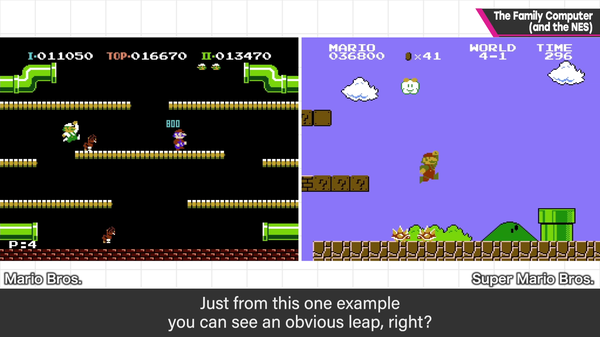
Sakurai also said the Famicom evolved into the much better NES thanks to an increase in ROM size and the introduction of custom chips. The console came with these custom chips, but players could also buy them separately.
The release of Dragon Quest III and the crowds of people lining up to buy it was proof of Famicom-mania in Japan in the 80s. Sakurai himself participated in this mania. He shared that he stood in line to get his hands on the Famicom Disk System on its release date.
Watch Story: Video Game Franchises Returning to Console
He gave credit to Famicom and NES for placing Nintendo in the modern game market. Now, Nintendo is gearing up for the launch of its latest console, Switch 2. What are your thoughts on the golden-age consoles? Let us know in the comment section below.
Written by

Edited by

Jito Tenson